Micheal's success story: Securing an internship at Bank of America
Micheal is a Computer Science graduate from the University of Leeds. He secured a Software Engineer Analyst role at Bank of America, through Bright Network. 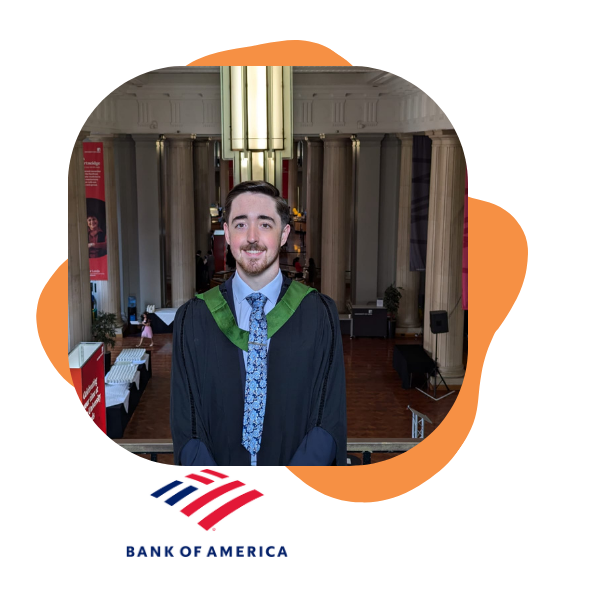
First, please tell us a little bit about yourself.
“Hi, I’m Micheal (pronounced me-hall), I’m a climber, techno enjoyer and love starting the day with a trip to the gym. My love for puzzles, solving problems, maths, and coding naturally lead me to pursue computer science and software engineering.
I’m the first person in my family to go to university and my grandparents were all Irish immigrants who came over in the 60s, which is where I get the special pronunciation of my name. I’m also proudly dyslexic and am a strong believer that it is a superpower and not something that has to hold you back.
Volunteering is another passion of mine, which is strongly supported by Bank of America. So far, as of late June, I’ve recorded 38 hours of volunteering, during work hours, with a goal of recording 50 hours by the end of the year, backed by my manager.”
What motivated you to apply for the role?
“Like everyone else in their penultimate year of university I was hunting for internships, and Bank of America initially stood out to me because the application didn’t want a cover letter, and instead wanted you to answer two short essay style questions, which I found a lot more approachable.
When you apply for the internship, you don’t apply for a specific team, you apply for a role, for example business analyst or in my case software engineer, and if you are successful in the application process you will be matched to a team based on your skills and the team’s preference. I was placed in the Equities Intraday Risk and P&L team; we work on apps that show our traders how much money they have made or lost so far today and how much money they might make or lose based on possible market moves.
A typical day for me includes, developing new features on our apps, investigating and fixing bugs found by our users and improving existing features; a feature I have recently worked on is modifications to the algorithm that distributes work across our computer grid.”
How did Bright Network help you secure this role?
“Bright Network was an invaluable tool when looking for opportunities as I could easily find relevant roles by filtering by internships, location and sector.
I set up email alerts for new opportunities and tracked deadlines for internships I was interested in, which allowed me to prioritise applications.
When it came to interviews and assessment centres, Bright Network had great advice on how to approach them and for most companies, they had a profile page which acted as a great springboard for deeper research and preparation.”
What was your application journey like?
“Once I’d submitted my application, which consisted of uploading my CV, grades and answering two small essay style questions, the second stage was a recorded interview. Unlike lots of companies, you could choose to re-record answers and there are also accessible alternatives available, so I’d recommend reaching out to the junior talent team if you think that would benefit you.
The final stage was an assessment centre, which was made up of three parts. The first part was a 10-minute presentation about a coding project I’d completed without any aids like PowerPoint, followed by 15-20 minutes of questions.
During the second behavioural interview, I was given theoretical scenarios to answer, before getting the opportunity to ask my interviewer questions. The final interview was a technical interview, which focused on quizzes about features of language I was proficient in, followed by some light design questions.”
What have you learnt from going through the process?
“The process reinforced my belief that quality is more important than quantity when it comes to internship applications.
The Bank of America application was one of my first and I put a lot of effort into it. I found that there was a high correlation between applications I spent a lot of time on and put effort into, and the applications that led to interviews and assessment centres.
It also reinforced how important it is to do in-depth research into a company ahead of an interview or assessment centre, because it leaves a positive impression on an interviewer when you can ask them about recent initiatives at the company.”
What are your tips for people looking to follow in your footsteps?
“Believe in yourself – it’s cliché, but important! Approach every room, virtual interview, or opportunity with confidence, knowing you deserve to be there and have something valuable to offer. And remember that, how you communicate often matters more than the specific words you use.
Focus on quality over quantity, as successful applications come from putting genuine care and thought into them. Prioritise crafting fewer, high-quality applications and avoid spreading yourself too thin.
My last piece of advice would be to highlight your passion projects. Having something you’re genuinely excited to talk about will help you stand out, whilst demonstrating your initiative. For technical roles, showcase personal coding projects outside of university coursework.”
Tell us about the future. What’s next?
“I’m about to finish my first year as a graduate in the team where I completed my internship. Being part of an incredibly supportive and knowledgeable team has given me a lot of room to grow, and I still have so much to learn from those around me.
In the short-term, I plan to continue my volunteering efforts and take on more responsibilities within my role.
Looking ahead, I’m excited about the prospect of managing people and leading a team, working to ensure that everyone has the opportunity and support to grow and achieve their ambitions.”
Find industrial placements, graduate jobs and more at Bright Network.
Looking to follow in Micheal's footsteps? Discover live graduate opportunities with Bank of America.