Reading time: 4 mins
Application process: Crafting your story for Macfarlanes
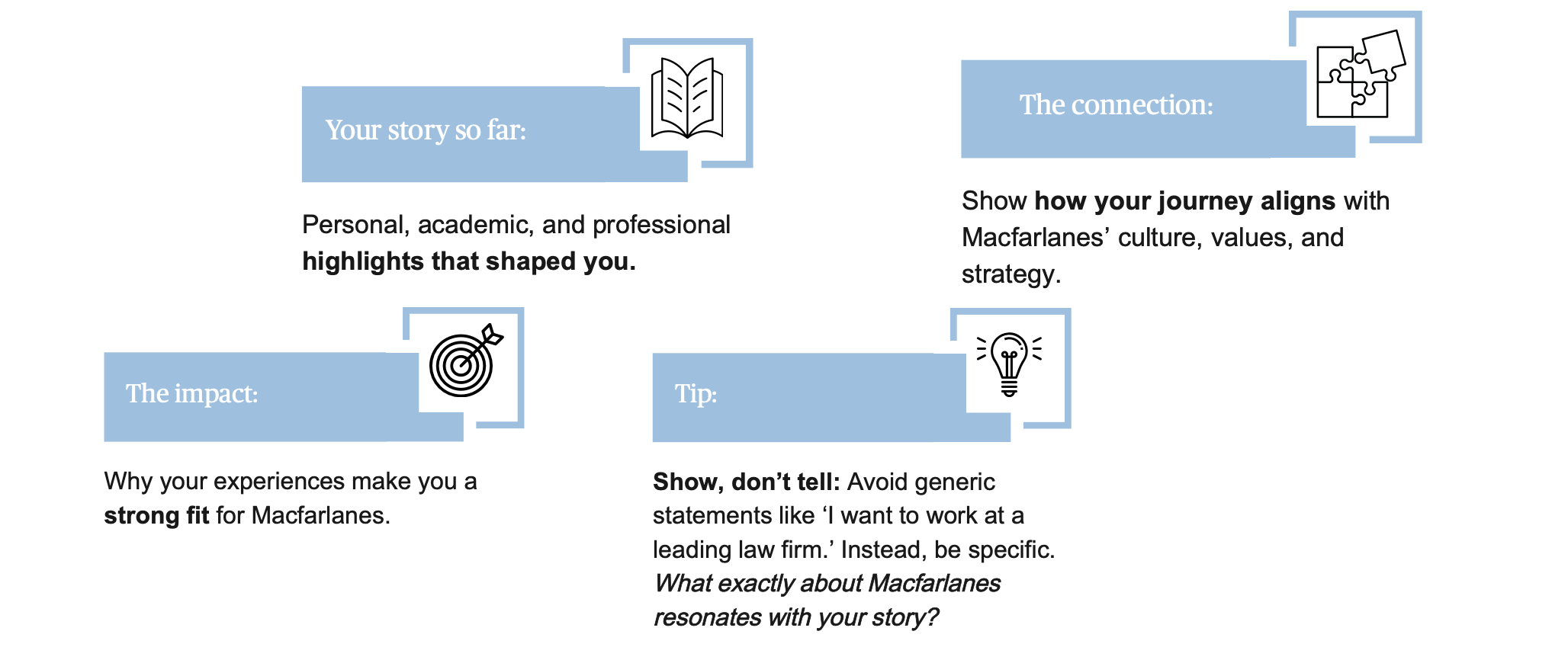
If someone were to read your story so far, what would make them think, “This person belongs at Macfarlanes?”
Human-Sized Culture
Human-sized culture means close-knit and collaborative. Highlight experiences that showcase teamwork, approachability, or a preference for meaningful professional relationships.
Independent Thinking
Means we pride ourselves on a distinct approach. Tell a story where you took initiative, made an unconventional choice or solved a problem in a creative way.
International Strategy
Through our good friends network of independent firms rather than overseas or satellite offices. Give an example of where you showed cultural sensitivity or why you value bespoke international collaboration over scale.
Technical Excellence and Intellectual Curiosity
Means we are known for high-calibre, complex work requiring real attention to detail. Share a time you went the extra mile to master a difficult concept, spotted a crucial detail others missed, or delivered high-quality work under pressure.
Longevity and Relationship-Building
Means we focus on long-term relationships – inside the firm and with clients. Share a time when you invested in building trust or rapport, even if it wasn’t the “quick” route.
Entrepreneurial Mindset and Client Focus
Means we value people who are commercially minded and proactive in finding solutions for clients. Tell a story where you anticipated a client’s (or colleague’s) needs, adapted your approach to suit them. or identified a creative opportunity to add value.
Application process: Answering the application questions
1. Research us
- Understand what makes us unique, our strengths and values.
- Show interest and understanding of the work we do. Be specific!
- Show motivation and long-term fit. Think about the key skills we’re looking for!
2. Authentic interests
- These can be academic or non-academic. Explain why they matter to you.
- Show the skills you have gained from your interests.
- Consistency is more important than perfection!
3. Pick one strong challenge
- This can be academic, professional or personal.
- Explain what happened → what you did → what you learned.
- Show persistence and problem solving.
- Link to growth and/or skill development.
4. Pick a meaningful achievement
- Explain the effort and skills behind it.
- What impact has this achievement had on you?
- Connect it to your future potential!
Stage One: Capptivate
Within Capptivate, you will learn more about Macfarlanes and the work we do. There are two key sections in this assessment – behavioural questions and critical thinking module.
This stage is designed to understand how you behave in a range of situations, and why. We ask you to:
- Order a few responses, from the approach you would be most to least likely to take in the given scenario, or those which sound most to least like you.
- Select the most appropriate response to the question or scenario, from those provided.
- Indicate on a scale, where you would most likely place your actions or views.
You will work through the five ‘tiles’ in this stage, but please be assured that everything you need – including tutorials, instructions and resources – is contained within the assessment.
Stage Two: Simulate
If successful at Stage 1, you’ll progress to Simulate, where you’ll be part of a (fictional) project team working on a (fictional) event.
Similar to Stage 1, Simulate is designed to understand your behaviours in a range of situations, and why. This time, we ask you to:
- Outline your approach to situations and challenges in the form of video and written responses.
- Indicate the approach you would be most to least likely to take in the given scenario, or those which sound most to least like you.
- Indicate on a scale, where you would most likely place your actions or views.
Throughout this assessment you will learn about various stages of the project, work with different colleagues and be required to handle a number of different tasks. Please be assured that everything you need – including tutorials, instructions and resources – is contained within the assessment.
Top tips for completing the assessments
Choose the right environment
- Find a quiet, comfortable space with a stable internet connection.
- Minimising distractions helps you stay focused and perform at your best throughout the assessment.
Understand the format
- Familiarise yourself with the types of questions you’ll encounter.
- These may include ranking responses, analysing data, and recording video answers.
- Knowing what to expect reduces anxiety and boosts confidence.
Reflect on your strengths
- Think about what you enjoy doing, what others say you're good at, and your proudest achievements.
- These reflections help you respond authentically and align your answers with your natural strengths.
Practice questions
- Try mock assessments or example questions that involve ranking, preferences and cognitive tasks.
- Practising helps you get comfortable with the format and improves your response speed and accuracy.
- Visit the Cappfinity Preparation Hub.
Prepare for video responses
- Keep in mind what is visible behind you whilst completing Simulate.
- Try and approach it in the way you would approach an in-person interview. You will be provided with an opportunity to test your microphone and webcam in advance of any assessed questions with a video response.
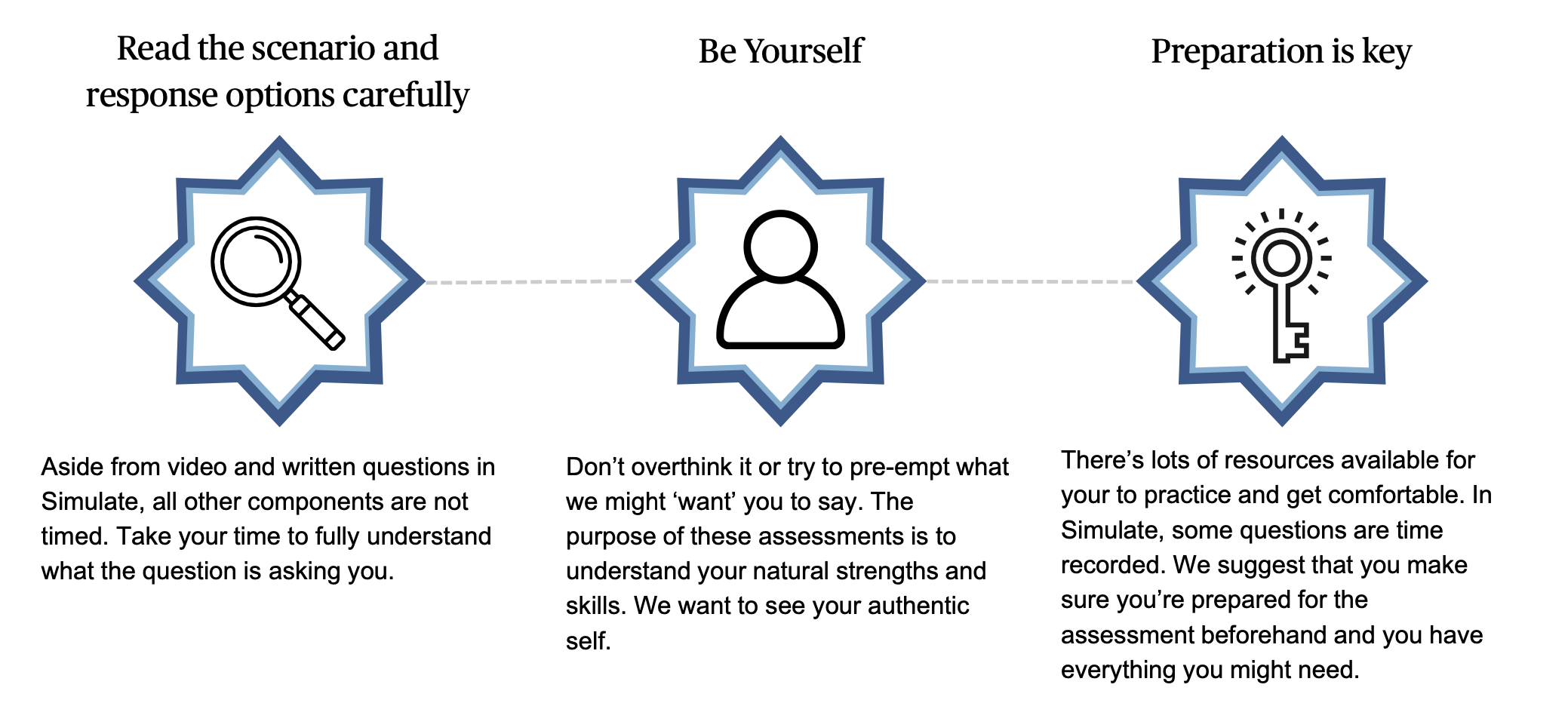
Be yourself
- Avoid second-guessing what assessors want.
- These assessments are designed to understand your natural behaviours and preferences, so honesty and authenticity are key.
- Relax, take a breath, and respond as naturally as you can.
The best advice we can give is...